







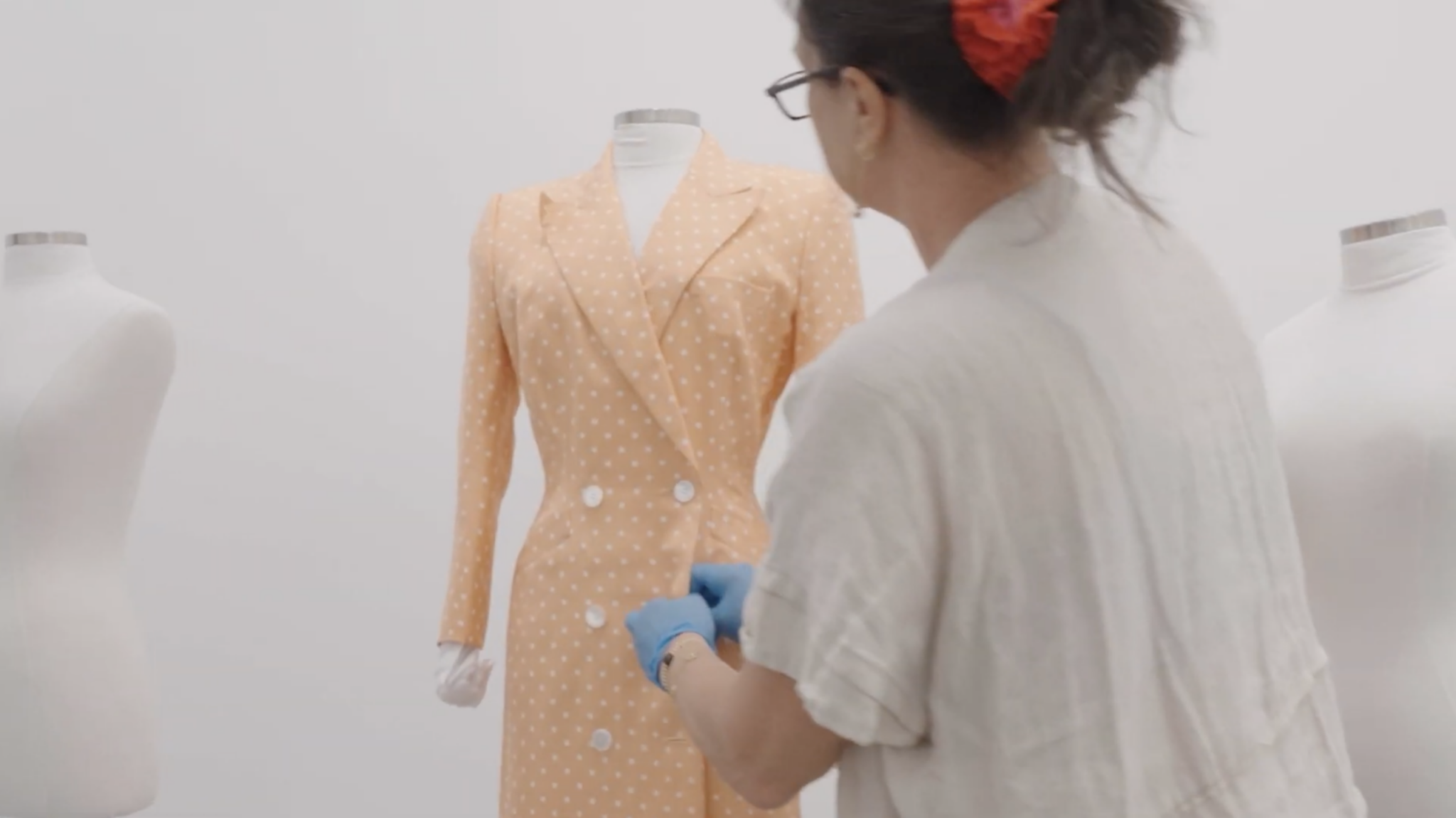
In partnership with UOVO, Renae Plant, founder of the Princess Diana Museum, is preparing her collection for its first public debut. The pieces emerging from storage are among the most recognizable garments of the twentieth century – skirts, gowns, and blouses spanning Princess Diana’s life. Watch as Renae prepares the collection for “Diana: Love Life Legacy” at the Ronald Reagan Presidential Library and Museum.

A First for the Collection Built Over a Decade
Plant began building the Princess Diana Museum a decade ago as a digital experience: an interactive, three-dimensional archive of more than 2,700 objects, assembled so that anyone, anywhere, could encounter them. It grew into one of the largest private collections dedicated to the Princess of Wales, spanning garments, letters, jewelry, childhood mementos, and the ephemera of a life lived almost entirely in public view.
The collection has always been accessible. It has never been physically present — until now.
That changes on November 7, when Princess Diana: Love Life Legacy opens at the Ronald Reagan Presidential Library in Simi Valley, California, running through May 31, 2027. More than 700 objects will be shown together for the first time, including the Bellville Sassoon “Caring Dress” that Diana wore nine times, and a Victor Edelstein gown worn at the White House in 1985.
Moving a collection from a digital environment into a physical exhibition is not simply a matter of shipping – it’s a matter of readiness, and readiness in fashion preservation is built long before an opening date.
Why Provenance and the Garment Label Matter
In a category where value rests on certainty, the label is the evidence. Provenance is what separates a beautiful dress from a historical document, and it lives in details that are easy to damage and impossible to replace: a signature, a maker’s mark, a hand-sewn tag, a hem altered for a specific occasion.
This is why provenance documentation shapes how we handle a collection like this one. Every piece is inspected and condition-reported before it enters storage. Garments are photographed and cataloged individually, then packed in archival materials — acid-free tissue, unbuffered board, padded forms that support a shoulder or a waistline without stressing the fibers around it. Structured pieces are stored flat or on custom supports rather than hung, because thirty years on a hanger is thirty years of gravity working against a seam.
The storage environment itself is climate-controlled, air-purified, and monitored continuously — a baseline requirement for any serious approach to museum-quality garment storage. Wool, silk, and fur are keratin-rich and attractive to pests, so incoming pieces move through isolation and low-temperature treatment before joining the collection. None of this is visible in a gallery, but all of it determines what a visitor sees when the exhibition opens.
Preparing a Collection for Public Exhibition
Exhibition preparation asks more of a collection than storage alone does. Objects have to be located, condition-checked against their intake records, mounted or packed for display, crated to travel, and returned — often on a schedule set by an institution rather than by the collection’s owner.
What makes an exhibition loan like this possible is the work done in advance:
- A complete and current inventory of every object in the collection
- Photography that documents condition at every stage, from intake to installation
- Archival packing designed around the specific vulnerabilities of each garment
Stewardship Is the Point
Diana’s wardrobe carries meaning far beyond its materials. These are objects people remember standing in front of a television to see – they belong to a shared cultural memory as much as to any single owner, and the responsibility that comes with holding them is closer to custodianship than ownership.
That is the work we care most about: not simply keeping objects safe, but keeping them ready to be studied, lent, exhibited, and seen. A collection that cannot leave the building is preserved. A collection that can is alive.
What It Takes to Museum-Ready a Collection
What does it take to prepare a fashion collection for museum exhibition?
A complete inventory, individual condition reports and photography, archival packing suited to each garment’s materials, and a climate-controlled storage environment maintained well before any loan is arranged.
Why does provenance matter so much in a fashion collection?
Provenance — signatures, maker’s marks, original labels, and documented alterations — is what turns a garment into a historical object rather than simply a beautiful dress, and it directly affects both authentication and long-term value.
Why is climate control important for storing garments and textiles?
Fabrics like wool, silk, and fur are organic materials vulnerable to humidity, light, pests, and temperature swings. Continuous climate control and air purification, along with pest-prevention protocols for incoming pieces, prevent damage that can’t be reversed.
Learn more about UOVO’s fashion preservation and archiving services.